

Customer service is one of the most demanding areas of business. People expect quick help, yet many still find themselves trapped in long menus, repeating details to multiple agents, and waiting for basic answers. These experiences frustrate customers and make life harder for the agents trying to assist them.
AI call routing changes this pattern completely. Instead of forcing people to navigate endless options, artificial intelligence directs each call to the right person or automated system from the very beginning. This single change leads to faster resolutions, smoother communication, and greater satisfaction for both parties involved in the interaction.
According to Deloitte, contact centers that apply AI routing report a 30% reduction in handling time and a 25% improvement in first-call resolution rates. The idea is simple: fewer steps, clearer direction, and smarter use of time. When calls reach the right destination immediately, everyone involved benefits.
How AI Routing Outperforms Traditional Systems
Routing technology has evolved from static decision trees to adaptive systems that analyze caller intent in real time. Earlier methods relied on fixed menus that treated every caller the same, often leading to repeated explanations and unnecessary transfers. Artificial intelligence eliminates that friction by listening, predicting, and connecting callers to the right destination from the start.
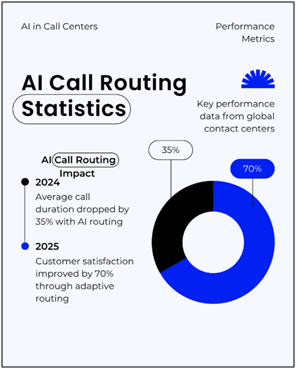
AI call routing transforms customer interactions through learning and responsiveness. Instead of forcing callers through multiple layers, it identifies patterns from speech, previous tickets, and context to resolve issues faster. Studies by IBM show that AI-driven routing can shorten average call durations while improving satisfaction ratings. Furthermore, research by ContactBabel reports that context-aware routing reduces customer frustration by 40% and increases agent productivity by 25%. These gains demonstrate how intelligent call center routing replaces repetition with accuracy, creating a smoother experience for both customers and agents.
Three Capabilities That Drive AI Call Routing
Artificial intelligence improves call management through several interlinked abilities. Together, these functions form the foundation of AI-powered customer service.
1. Predictive Call Routing
Predictive systems study customer information, recent activity, and historical data to anticipate intent. Before the call connects, the system already knows what the customer is most likely calling about. This helps reduce wait times, eliminate misrouted calls, and direct customers to agents with the right expertise. This means that predictive systems can reach 80% accuracy in matching customers to the correct department on the first attempt.
2. Natural Language Processing (NLP)
Natural language processing allows callers to describe their issues in plain speech. The system understands the meaning and context of the words instead of depending on button selections. This capability replaces rigid menu navigation with a more intuitive conversation that moves directly to the right destination. Simply put, NLP systems can lower average queue times by 30% and improve first-call resolution by 15%.
3. Automated Handling
Automated handling supports agents by managing repetitive questions and tasks. It resolves routine matters such as balance checks, account updates, or appointment confirmations instantly. Therefore, automation now resolves 40% of customer inquiries without agent intervention. Agents are then free to handle detailed requests that require reasoning or decision-making.
When combined, these capabilities transform how support centers operate. Calls are answered faster, agents work with better information, and customers receive a level of responsiveness that traditional routing could not provide.
Proof from Real-World Results
The practical impact of AI routing is visible across industries. Businesses that use it report measurable improvements in resolution times, satisfaction scores, and staff efficiency.

Automated Call Routing
Companies adopting automated routing often see a significant reduction in average wait times. By analyzing caller intent and matching it to available expertise, calls reach the correct destination immediately. This structure improves first-call resolution rates and lowers the need for callbacks.
AI-Powered Virtual Agents
Virtual agents manage a growing portion of contact center volume. This means agents spend more time addressing complex cases that require judgment or empathy, which increases job satisfaction and overall service quality.
Real-Time Sentiment Analysis
Real-time sentiment tracking enables organizations to respond to emotions during live interactions. The system identifies frustration or confusion and alerts supervisors or adapts responses instantly. Businesses using this feature report up to 15% higher retention and improved post-call ratings.
These outcomes reflect a clear pattern: when contact centers use intelligent call center routing, the customer experience improves and operational strain decreases.
The Broader Value of Intelligent Call Center Routing
AI routing is not a simple efficiency upgrade. It redefines how organizations think about service delivery. The benefits extend beyond shorter calls or lower costs. The technology provides insight into what customers value most and how agents perform under different conditions.
Managers gain access to real-time analytics that highlight areas for improvement. Performance reports show where bottlenecks appear and where automation creates the greatest return. Over time, these insights help businesses refine training, scheduling, and workflow to maintain consistent quality across every interaction.
AI-based routing can reduce operational costs by up to 25% while maintaining higher consistency and satisfaction levels. For customers, the result is simple: they receive faster help from people who already understand their needs. For companies, it creates a structure that supports growth without sacrificing reliability.
Building a Roadmap for Implementation
Implementing AI call routing requires structure and patience. The most successful companies follow a step-by-step plan that allows the system to learn gradually and adapt to real-world demands.
- Start with a single use case. Identify one area with high call volume or frequent misrouting.
- Assess current systems. Review how your CRM, ticketing software, and communication platforms connect to the new AI system.
- Integrate carefully. Feed accurate, labeled customer data into the system for better learning.
- Clean your data. Update outdated entries and remove duplicates before going live.
- Run a controlled test. Begin with one department, measure results, and make adjustments based on feedback.
- Track results consistently. Monitor average handling time, resolution rate, and satisfaction metrics to evaluate progress.
- Expand gradually. Once stable, extend the system across departments with documented improvements.
This structured approach allows companies to introduce AI routing without disrupting daily operations. It builds confidence internally and produces measurable progress over time.
The Customer Experience Advantage
AI routing benefits customers and support teams equally. Callers receive accurate assistance the first time they reach out. Agents handle fewer repetitive tasks and more meaningful interactions. Managers receive data that highlights performance in clear, actionable terms.
Every improvement reinforces the next. Faster response builds trust, and trust leads to loyalty. Over time, that loyalty becomes a measurable business advantage built on service that feels dependable, consistent, and personal.
Conclusion
AI call routing represents a clear change in how customer service operates. It connects people faster, reduces confusion, and helps agents focus on what truly matters, which is resolving issues efficiently.
Companies that plan their adoption carefully will see lasting results. Clean data, trained staff, and steady testing create a foundation that continues to improve with use. Intelligent call center routing is not a passing trend. It is a practical solution that improves accuracy, consistency, and customer confidence with every call. The organizations that implement it with care will lead the future of service by delivering responses that feel direct, reliable, and human.
To learn more about AI-powered customer service, contact Oculus Systems today.
Frequently Asked Questions
1. What is AI call routing?
AI call routing analyzes customer data, intent, and past interactions to connect callers to the right agent or self-service option within seconds, reducing wait times and misrouted calls.
2. Does it replace human agents?
No. It manages repetitive requests like balance checks or appointment confirmations so agents can focus on complex issues that require reasoning or empathy.
3. How accurate is AI routing?
Systems reach up to 80% first-call accuracy and shorten average call times by 30%.
4. What industries use it?
Healthcare, banking, airlines, and telecom companies use it to improve service efficiency and consistency.